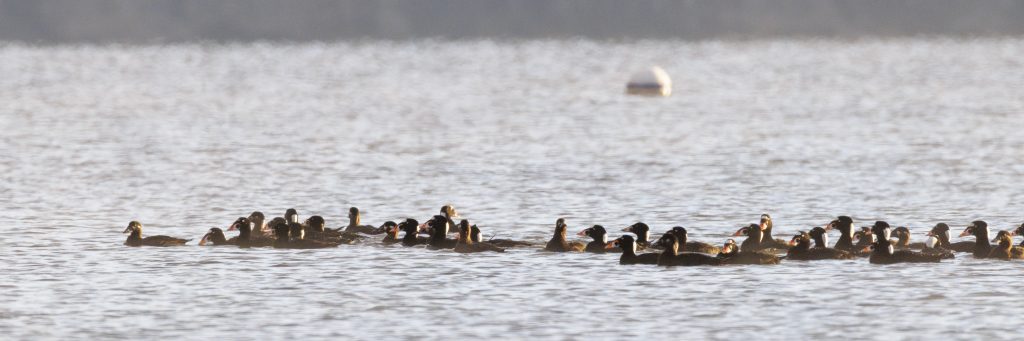
We have lots of birds that winter in Honeymoon Bay. To name a few, our year-round visitors are Mallards, Canada Geese, Osprey, Bald Eagles, Blue Heron, __ Cormorants, Gulls, Ravens and lots and lots of Crows. Our winter visitors are mostly deeper water species including Buffleheads, Barrows Goldeneye, Common Merganser, Pigeon Guillemot, and last but not least: Surf Scoters.
The feeding patterns of most ducks seems fairly erratic or chaotic, and groups of ducks seem fairly loose or fluid. Not as true for Surf Scoters though. They often form up in straight lines of 100 or more birds and progress across the bay in unison. Sometimes, they stop and dive, again as a group. Suddenly, the large group of ducks can virtually disappear. About 20 seconds later, y the Scoters bob back to the surface like a bobber with a fish on. Then they reform in ranks and off they go. So what is this about, I wondered?
I have been frustrated in how little information about Surf Scoter hunting habits I was able to find in Google searches. So I gave AI a try, and it tells me:
Synchronized Diving
Surf scoters are highly social sea ducks that hunt in synchronized groups called rafts, which can range from a few birds to several thousand. This collective behavior is most prominent during their winter stay on temperate coasts and their spring migration. [Birds of the World +3]
The most distinctive aspect of their group hunting is synchronized diving. [Bird Watcher’s General Store +1]
- The Mechanism: When one bird in the flock dives, the entire group often dives in unison, disappearing from the surface and reappearing together.
- Efficiency: This synchrony is directly correlated with group size—larger flocks tend to dive more simultaneously.
- Purpose: Scientists believe this helps the group relocate profitable feeding patches together. It may also provide protection by making it harder for “kleptoparasitic” birds like gulls to single out an individual to steal its food once it surfaces. Facebook +4
Foraging Tactics and Prey
Surf scoters primarily target benthic invertebrates on the ocean floor, typically at depths less than 30 feet, though they can dive up to 65 feet if necessary. [Washington Department of Fish and Wildlife (.gov) +2]
- Mussel Bed Strategy: They often target complex habitats like mussel beds, using visual cues to locate smaller bivalves that they swallow whole.
- Sediment Plowing: Similar to other scoters, they likely use their powerful bills to plow through soft sediments to find buried prey like clams and worms.
- Herring Spawn Opportunism: In early spring, large rafts gather in shallow waters to feast on Pacific herring eggs. During these periods, they increase their dive duration and move in massive, chaotic groups to take advantage of the sudden abundance of roe. Birds of the World +6
Group Dynamics
- Flock Formations: When moving between feeding areas, these loose flocks often string out into irregular, wavy lines.
- Territoriality: While they are highly social in winter, males become extremely territorial during the breeding season, defending a “moving space” around their mate from other males. [Birds of the World +1]